


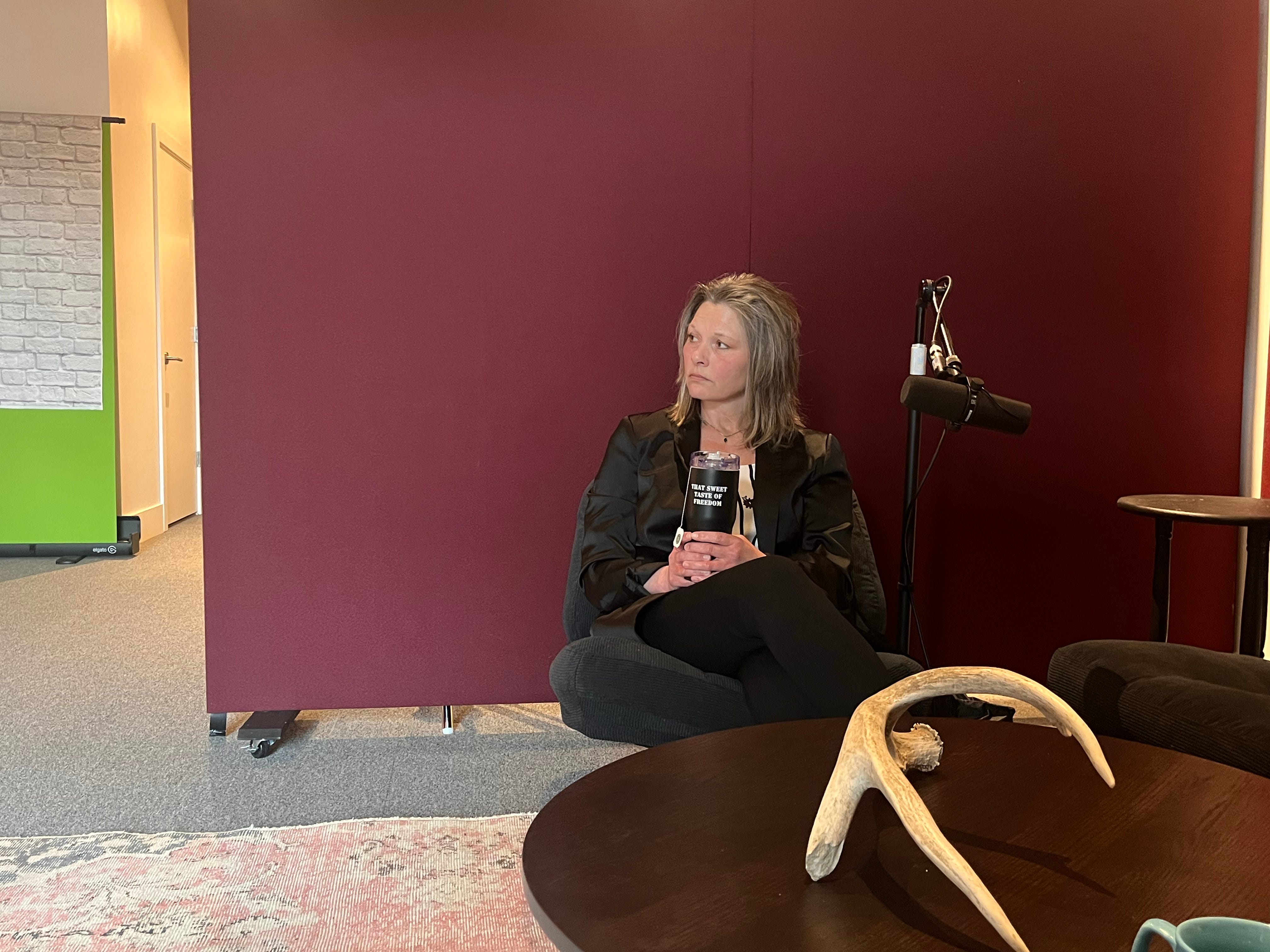
Kathy Flett at HAQ Story Studios in Edmonton. Danielle Paradis
About 15 people stand on a small bridge over an Edmonton freeway, waving flags. Only Alberta flags.
Below, drivers, mostly in big trucks, honk their support. A few yell something less friendly.
“You can only kick a dog so many times before he’s gonna bite you back, and I’ve been kicked,” says Scott Russell, a natural-gas pipe fitter in his 40s who was holding one of those flags.
On Oct. 19, Albertans will find 10 referendum questions in the voting booth. One of those questions asks whether the province should hold a binding referendum on leaving Canada.
The road to that ballot started with separatists gathering more than 220,000 signatures in support of the question, “Do you agree that the province of Alberta should cease to be a part of Canada to become an independent state?” A provincial judge threw out the petition because the province had a duty to consult First Nations, and it didn’t.
Listen now
Premier Danielle Smith then created a new referendum about whether to hold a referendum.
It’s important to note that it isn’t binding. Smith says a majority vote will trigger a full referendum on separation.
For the first episode of our podcast, Separation Anxiety, we spent the summer among some of the organizers and supporters of the movement who want out.
We went to a freeway overpass, a rural café, a Calgary church and of course, a Tim Hortons to ask them why.
‘I’ve been kicked’
For Russell, the ‘kicking’ started when people called him a Nazi a few years ago. He says it happened after he spoke out on Facebook against vaccines and COVID-19 lockdowns.
He’s unhappy about plenty else. Immigrants are a big one; he says they’re drowning Canada’s health-care system. But what pushed him toward separation, he says, is money.
“All the prosperity’s being pulled out from under us,” he says. “Every dollar you have to spend in taxes that you don’t have, or every time you have to like not do something with your kids or make hard decisions, like it takes a very massive toll on your health and your kids’ health.”
He points to groceries. “When you have three children, like it’s very difficult to afford that and still have their recreational activities and clothes and school supplies, right? And play that out 10 years and see what happens.”
Asked how independence would fix that, Russell cited a figure he’d read about equalization payments. “If we didn’t have to give like 330 billion ... I’m sure a lot of that could go back to a tax cut for the middle class.”
The closest number we could find was $321 billion. That figure, from the Fraser Institute, calculates Alberta’s net contributions to the federal treasury over the past decade.
It doesn’t mean Alberta wrote Ottawa a cheque. The Canada Revenue Agency collects income taxes for both the province and the federal government. From that pot, Ottawa sends money back to provinces and territories through transfer payments, which Alberta receives every year. What Alberta usually doesn’t receive are equalization payments, which redistribute taxes collected in provinces that have a lot to provinces that don’t.
Dennis Young, also on the bridge, put it more bluntly. “If you put it in terms of prosperity, Canada is our adversary,” he said. “We would be wealthier without being Canadian.”
Love for a bygone Canada
Something else comes up often at sovereignty protests, and it’s a little ironic: a love for Canada, or at least an older version of it.
Russell explained this through his recent stroke. In hospital, he says, it felt as though staff had to meet cost quotas, as if the system was threadbare and didn’t see his life as valuable anymore.
“The country, the land, the people, I love it,” he says. “But like this federal government and the system, you are darn right that I hate the guys who hate me.” He says health-care workers asked him whether he wanted to be resuscitated. “Like, no, man, I’d rather live.”
Faith is part of it for him, too. “I think we need God in this country,” he says. His brother-in-law once asked if he was a Christian nationalist. His answer was yes.
“Everyone else gets to have a nation. Everyone else gets to have their heritage. Where’s my heritage? Well, it’s in Alberta.”
‘We can’t fix it’
Kathy Flett is co-creator of the Alberta Women for Independence Network, which she started to talk to women about separation. She came to our studio while the petition was still gathering signatures.
“I’m an Alberta girl,” she says. “This is where I was born. Is all I know.”
Asked why women hadn’t felt connected to the movement, in a province with a strong female premier, Flett said women like to fix things. Her pitch is that they can’t.
“Confederation isn’t broken, is working exactly like it’s designed, and there’s nothing we can do, other than remove ourselves from that which isn’t working for us,” she says.
Flett grew up in oil and farming country in Peace River, four hours northwest of Edmonton. As a teenager, she read the Alberta Report, a deeply conservative weekly with an almost mythic standing among people who worked in or cared about the resource economy. It taught her more than school did, she says.
Both of her sons were born in Fort McMurray. “That’s what put shoes on our feet. That’s what made sure my babies were fed,” she says of oil. What bothered her was the message she felt she heard from outside the province: “how dare you” be proud of those resources.
Right now, she says, being Albertan “means you’re under the thumb of Ottawa.”
As a republic, it would mean choice in schools and health care “without Ottawa saying, ‘Well, we’re not giving you your money unless you do it our way.’”
Flett says an independent Alberta would use its oil to make deals with other countries, and wouldn’t be afraid to turn off the taps. Alberta is landlocked, and Canada might have less interest in letting an independent Alberta run a pipeline through its territory to the coast. That doesn’t faze her.
“Well, we will be a petro state,” she says. “The rest of Canada needs to know that we now have the power to go there if we need to, and we will.”
Every inch of Alberta is treaty land. Asked what she would tell a First Nations person living on reserve, Flett said First Nations people come to her events and have signed the petition. “It’s not really working out for them well either,” she says. “It’s an excellent opportunity for all of us to be able to have a do over.”
The province on the hill
The phrase that kept coming up in our conversations was Christian nationalism.
On a Sunday in August, more than 150 people filled Fairview Baptist Church in southeast Calgary. Its pastor, Tim Stephens, was born in the Ottawa area and earned an engineering degree at Queen’s University. After becoming a Christian, he studied at Detroit Baptist Theological Seminary and earned a doctorate at The Master’s Seminary in California. He came to Alberta to work in oil and gas after university and has spent most of his adult life here.
During the pandemic, his church kept meeting. Complaints led to tickets, court orders and enforcement, and Stephens spent three weeks at the Calgary Remand Centre.
“You’re treated like a criminal. You’re like an animal. You’re in a cage,” he says.
Stephens has written about why Alberta independence matters to the church. He rejects the idea that faith should stay “between people’s ears.” An independent Alberta, he says, would have to be built on Christianity.
“I think there can be no other way,” he says. “The values that people in Alberta are longing for are Christian values … this is not just a matter of pipelines or economics.”
Asked whether he’s a Christian nationalist, he said the term was coined as a pejorative. “Do I want a Christian nationalism? Do I want a pagan one? Do I want an atheistic one? Do I want a Marxist one? Yeah, I want a Christian one.”
He draws a line around the version he doesn’t want: one that looks like Iran, or a “Christian prince” who comes in to clean house. A Christian nation, he says, will emerge through the Great Commission, by “making disciples of the Lord Jesus Christ.”
‘Frustrated partisanship’
Michael DeMoor teaches politics at The King’s University, a small Christian university in Edmonton, and studies attempts to make Christian nationalism intellectually respectable.
After listening to Stephens talk about scripture’s separate spheres of authority, meaning family, church and government, DeMoor noticed that the pastor moved quickly to where the country is going collectively, and how secular it’s becoming. That, he says, is the point where “a sociologist might say that sounds like Christian nationalism to me.”
He’s careful with the term. At its broadest, he says, it’s what outsiders call conservative Christians engaging in politics. “In the ‘80s we called them the religious right. In the Bush two era people called them theocons. Now we call them Christian nationalists.”
He also notes the idea isn’t new in Canada. When the federal government set out to assimilate Indigenous people, it handed residential schools to churches, because “becoming Canadian had to mean becoming Christian.”
DeMoor is a Christian, but not a Christian nationalist. He calls it “a profound theological error” to think the state should be Christian. In his tradition, the state’s task is public justice and protecting the vulnerable: “the widow, the orphan, and the stranger.”
So is Alberta separatism a Christian movement? DeMoor doesn’t think faith is “what’s driving the boat.” Christians are an important part of the coalition, he says, but his diagnosis is that separatism is driven by frustrated partisanship: Albertans who win provincially and lose in Ottawa, over and over, until leaving starts to sound reasonable.
“If the Conservatives had formed a government federally after the election of 2021, we would not have a separatist movement that has anything like — we wouldn’t be making a podcast about separatism right now,” he says.
A nation built from grievance?
Prosperity, health care, faith, a Canada people no longer recognize. The separatists we met named different reasons, but they share a sense that the country is working against them.
Whether that can hold together as a nation is an open question. Alberta’s own conservative parties have split apart roughly every decade.
Flett, for her part, isn’t worried about the unanswered questions.
“Everything’s figureoutable,” she says. “It’s all figureoutable.”